
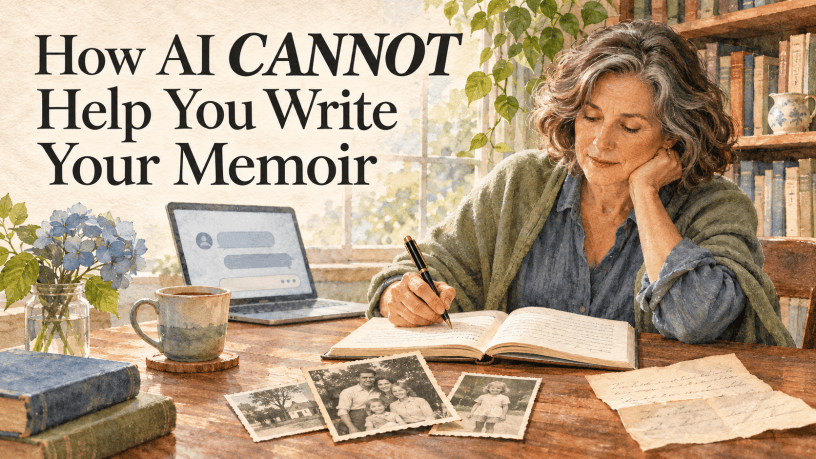
AI can help you organize, edit, and refine your memoir, but there are many things it cannot do. Writing memoir is a highly personal venture. It is helpful to remember what AI can’t do for you as you put your personal memories to paper.
DISCLAIMER: This post was written by AI and edited by me.
AI cannot verify your family’s past for you
AI may suggest records to look for or help you plan research. Any factual answer it gives still needs checking against reliable sources.
If you want to know when a school opened, whether a hurricane occurred in a particular year, or where a relative lived, consult the relevant records. Open the sources yourself. Confirm that they support the specific claim.
For memoir and family-history writing, keep track of the distinction between:
- What you personally remember.
- What another person told you.
- What a document establishes.
- What you infer.
- What remains unknown.
A record may establish that your grandmother moved in 1937. It may say nothing about why she left or how she felt. Those questions remain open unless you have further evidence.
Where AI Falls Short: The Irreplaceable Human Heart
As handy as AI is with words, it doesn’t have a body, a heart, or a conscience. It has never fallen in love, lost someone it cared about, made a painful mistake, or stayed awake at night wrestling with regret. The moment you ask AI to do the work of your memory and heart, the writing loses the very thing that makes memoir worth reading.
1. It Has No Lived Experience
AI doesn’t know what your grandfather’s voice sounded like when he was upset. It doesn’t know the exact chill of the waiting room where you got bad news, or that strange mix of pride and panic you felt on your wedding day.
If you ask AI to write a scene from scratch, it will fall back on generic clichés. Memoir lives and dies on specific, sensory details, and only you have those.
2. It Cannot Decide What an Experience Means
A memoir isn’t just a list of things that happened to you; it’s a search for meaning.
What separates a basic timeline from a compelling memoir is your own self-reflection: Why did I make that choice? How did that loss change the way I trust people? Who was I back then, and who am I today?
AI can mimic thoughtful language, but it can’t do the hard emotional work of figuring out what your life means. That insight has to come from you.
3. It Cannot Ensure Factual Accuracy
AI generates text that sounds convincing, but it doesn’t fact-check itself.
If you ask it to help describe an event or give you historical background, it might casually invent details, misquote sources, or scramble dates.
In memoir, the trust between you and your reader is everything. If readers catch fabricated details, that trust is broken.
4. It Erases Your Unique Voice
We all have our own rhythm, vocabulary, and way of looking at the world, shaped by where we grew up, our families, and our unique quirks.
Because AI models are trained on massive amounts of average text, their default style is smooth, bland, and generic. If you rely too heavily on AI to polish your prose, it will smooth out all the distinct personality, cadence, and charm that make your writing sound like you.
Remember that AI is your ASSISTANT, not you!
5. It Cannot Make Ethical Decisions About Other People
Writing a memoir means writing about the people in your life: your parents, partners, kids, and friends. That comes with real ethical weight. You constantly have to balance telling your truth with respecting other people’s privacy.
AI can’t weigh the emotional fallout of sharing a family secret, tell you when to use a pseudonym, or help you figure out how to have a hard conversation with a loved one before your book comes out.
Practical Rules for Using AI Responsibly
If you decide to bring AI into your writing process, setting clear boundaries will protect both your story and your peace of mind.
- Think twice before uploading private details. Be careful about pasting highly personal medical records, identifiable information about living people, or sensitive legal issues into public tools. Always check the privacy settings of whatever platform you’re using.
- Draft your raw memories yourself first. Never let AI write the first draft of an emotional scene. Get your memories down on paper in your own messy, honest words first. Bring in AI only after your truth is already on the page.
- Treat suggestions as ideas, not orders. When AI suggests an edit, treat it like advice from an acquaintance. Keep what helps, toss what feels fake, and rewrite anything you keep so it sounds like your voice.
- Double-check every fact. If AI suggests a date, a historical fact, a song title, or a quote, look it up yourself using trustworthy sources or your own records.
- Save your original drafts. Keep a backup folder of your own untouched writing before you run anything through an AI tool. That way, if an edit takes your prose in the wrong direction, you can always jump right back to your authentic words.
The Story Belongs to the One Who Lived It
At the end of the day, writing a memoir is an act of courage. It asks you to look back at your life honestly, sit with your vulnerabilities, and share your journey so others can feel a little less alone.
Technology can help you format your chapters, find a stronger verb, or sort out a messy timeline. But it will never be able to give your book a soul. The heart of your memoir won’t come from an algorithm; it comes from your willingness to tell the honest truth about what you’ve lived through.
Feel free to use the tools at your disposal to support your craft, but keep yourself firmly in the driver’s seat. It’s your life. Only you can tell it.
Read How AI Can Help You Write Your Memoirs
Have a story you want to preserve? Lifetales Media offers interviewing, writing, editing, and coaching to help you turn your memories into a book. Visit lifetalesmedia.com.

QUICK NOTE: I never use AI (other than for grammar) when I create stories for other people. I might suggest that YOU use it to help you get organized, but I would never use it to write for clients. What you get from me is all me, and you are free to use it as you see fit. In affect, I am your ghostwriter.

