

Images are AI generated
Disclaimer: I used AI to suggest headings for this post as an example of how you can take YOUR thoughts and ideas and use AI to help organize those thoughts and ideas.
Writing a memoir is one of the most rewarding things you can ever do—and let’s be honest, one of the scariest. Unlike a novelist, you can’t just invent a plot twist when you write yourself into a corner. And unlike a journalist, the story you’re investigating is your own: your mistakes, your family history, your vulnerabilities, and the messy, unvarnished truth of your life.
When you sit down to turn decades of living into a cohesive book, it’s easy to feel overwhelmed. You’re staring down old journals, half-remembered conversations, emotional baggage, and that intimidating blank page.
So it makes complete sense that you might be curious about artificial intelligence. A tool that can quickly organize scattered notes, suggest outlines, or clean up clunky sentences sounds like a lifesaver. But memoir is a very special kind of writing. People don’t pick up a memoir just for polished prose; they read it to connect with another human being who is being honest about what life actually feels like.
To write a book that truly connects with readers, you need to know where craft ends and soul begins. AI can be a fantastic assistant when it comes to the mechanics of writing, but it can never give you the lived experience, emotional truth, or ethical judgment that make a memoir powerful.

Everyone has an opinion about AI these days. I think of AI as an assistant. Here’s the thing: you feed AI the facts, your sentence drafts, and it refines them, improves them, and suggests new avenues. It is there to ASSIST YOU. The content is still YOURS.
You have stories you want to preserve: the kitchen where everyone gathered, the move that changed your family, the decision you still think about years later. You may also have notebooks, photographs, half-finished chapters, and no clear idea how to bring them together.
Artificial intelligence can help with parts of that work. It can suggest questions, organize material, and point out places where a reader may need more explanation. But a memoir asks for something a tool cannot supply on its own: your account of what you lived, what you remember, and what you now understand.
The most useful approach is to give AI a specific job while keeping responsibility for the story yourself.
Let’s walk through what AI can genuinely help you with, where it hits a hard wall, and how you can use it while keeping your authentic voice front and center.
Where AI Can Help: Your Creative Assistant and Sounding Board
Think of AI less like a ghostwriter and more like an eager editorial assistant sitting across from you. It can’t write your story for you, but it’s great at clearing away the administrative clutter and structural roadblocks that slow you down.
1. Organizing Scattered Notes and Timelines
Most memoirists start with a jumble of pieces: shoeboxes of letters, random journal entries, and memories scattered across decades. AI is genuinely great at spotting patterns and sorting through chaos. You can paste in a messy pile of notes and ask it to:
- Build a clear, chronological timeline of events.
- Group memories around recurring themes, like family traditions, career turning points, or grief.
- Spot natural chapter breaks based on major shifts in your life.
AI can generate focused prompts around a subject you choose. Try:
Ask me five open-ended questions about my first job. Ask one question at a time. Do not assume what happened or suggest how I felt.
USING YOUR TIMELINE
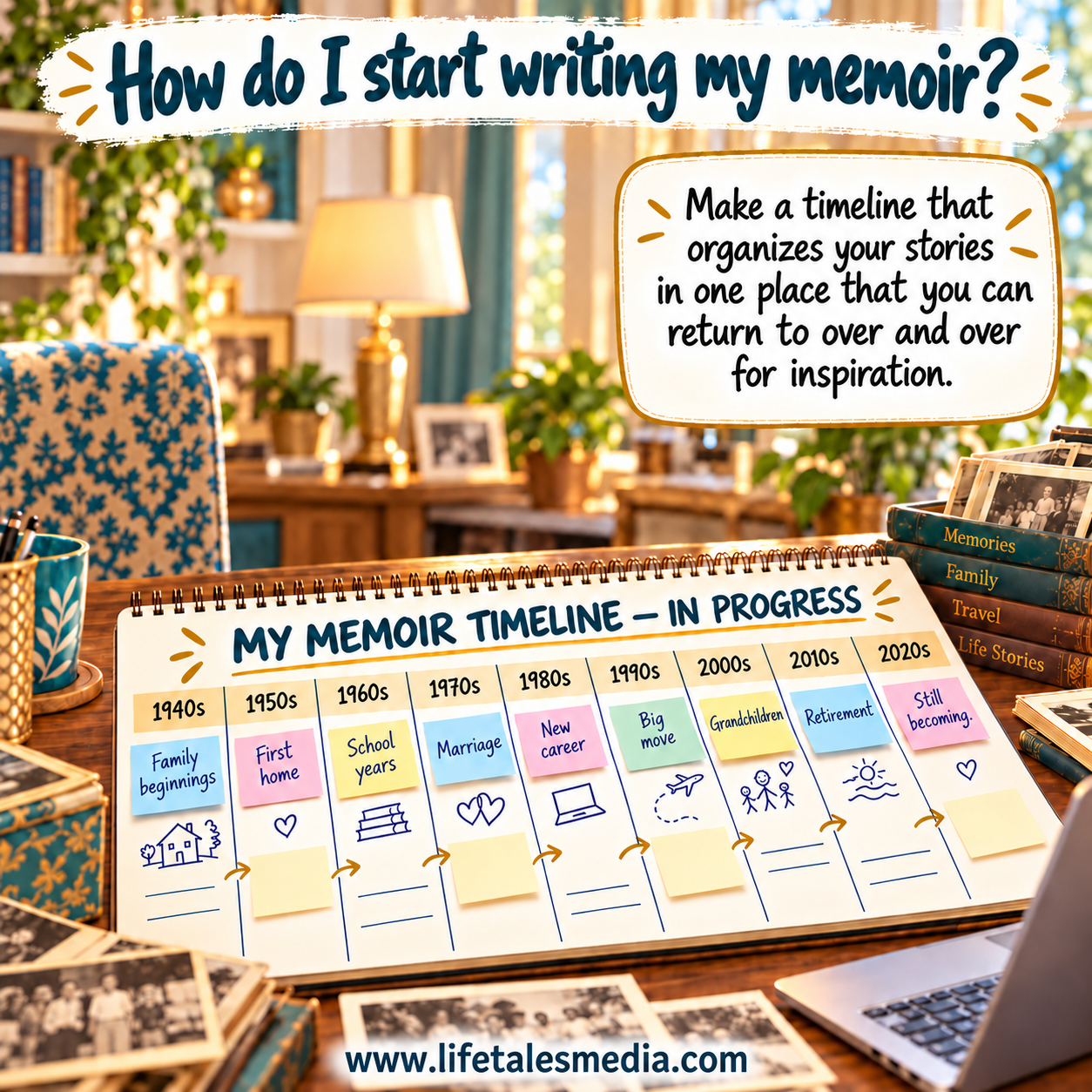
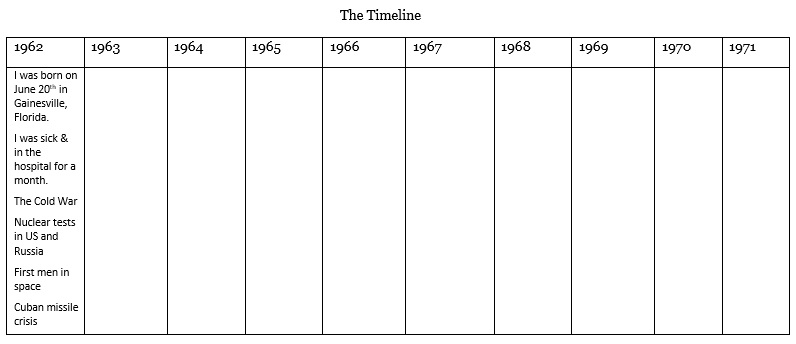
I used my timeline to ask AI how to organize it into chapters. It not only gave me an outline summary, it gave me a suggested theme.
- My prompt: Suggest a way to organize this timeline into chapters.
- AI’s answer: “I suggest a mostly chronological memoir, with chapters built around changes in home, family, and your sense of yourself. Your timeline contains a recurring pattern worth exploring: moving, making a home, caring for others, and beginning again. A possible guiding question is: “How did I build a life of my own while my idea of home kept changing?” That gives the events a connecting thread without deciding in advance what every experience meant.”
I found this response useful because I had never actually thought about how my life was centered around constant moving and searching for ‘home.’ This gave me a theme to work with as I wrote specific scenes of my life.
2. Generating Sensory and Reflective Prompts

When you’re struggling to recall a specific time in your life, AI makes a great interview partner. If you’re trying to describe your childhood kitchen back in the 1970s, you might ask: “What sensory details, everyday objects, or background sounds might help trigger memories from that era?” It won’t know what your kitchen actually smelled like, but its suggestions might jog your memory enough to remember the sound of the refrigerator buzzing or the sizzle of butter in the skillet.
You can also ask for a small writing task suited to the time you have:
Give me one memoir-writing exercise I can complete in five minutes, focused on a familiar room.
The prompt helps you start. Your response supplies the story.
My AI Experience
I used the above prompt and received this answer:
Five minutes in a familiar room. Choose a room you know well—from childhood or your life now.
Minute 1: Picture yourself standing in its doorway. Name three things you see, one sound, and one smell.
Minutes 2–4: Write about one small moment that happened there. Begin: “In this room, I remember…” Include an action: someone stirring coffee, folding a towel, opening a window. Use the details you remember; leave uncertain ones out.
Minute 5: Finish with: “What I understand now about that moment is…”
Keep writing without editing. A single paragraph is enough.
If you don’t like the prompt it gives you, ask it to do the same thing but change the prompt. Answers will differ depending on what AI platform you are using. Try different ones!
3. Exploring Structural Approaches
There’s no single way to structure a memoir. You can go chronological, weave multiple timelines together, tell it in episodes, or jump straight into the action. If you feel stuck in a linear draft that’s dragging, you can share a quick summary of your arc and ask for three different ways to frame the journey. Seeing alternative structures can help you look at your story with fresh eyes before you spend weeks down the wrong path.
My AI Experience
AI gave me an outline that included three parts and sixteen chapters. It further offered this suggestion:
How to make this manageable
For each chapter, begin with three scenes you can actually remember, rather than trying to cover every event in its date range. Then ask:
- What did I want during this period?
- What complicated that?
- What changed by the end?
- What do I understand differently now?
Moves, jobs, and dates can connect the scenes in brief passages. Pets, family celebrations, friendships, and ordinary pleasures deserve space wherever they mattered; they can show the texture of your life alongside its harder events.
These are very helpful suggestions, ones I might have received in a writer’s workshop.
Given a list of your stories, AI can suggest arrangements: chronological chapters, sections organized around places, or a thematic structure about work, belonging, caregiving, or change.
A useful request is: Using only these story summaries, suggest three possible structures. Explain what each would emphasize. Identify missing information as questions; do not fill it in.
My AI Experience
Prompt: Using only these story summaries, suggest three possible structures. Explain what each would emphasize. Identify missing information as questions; do not fill it in.
I chose three summaries from the chapter outline AI had given me earlier.
It’s response:
Based only on these three summaries, here are three possible structures. Each would give the same events a different emphasis.
1. Chronological: A Life Through Change
Follow the sequence already suggested:
What it emphasizes: How events accumulated over time, allowing readers to follow changes in your daily life and circumstances. The degree, wedding, publication, and community activities would receive space alongside loss.
2. Thematic: Work, Relationships, and Home
Organize chapters around three overlapping subjects, moving chronologically within each:
What it emphasizes: The development of particular areas of your life across several years. Readers could follow your writing life, for example, without its being interrupted by every other event.
3. Braided: Writing Alongside Personal Change
Alternate between two chronological strands:
- The public and working life: Teaching, publication, speaking, work changes, the master’s degree, and writing.
- The personal life: Relationships, caregiving or family experiences described in the summaries, deaths, health, moving, therapy, and attempts to make connections.
Pair sections only where your memories support a meaningful connection.
What it emphasizes: What was happening in your personal life while you were working, publishing, studying, and speaking. This structure could give both strands sustained attention.

Treat the results as options. An orderly outline may give too much space to events that matter little to you, or place your most important experience in the background. Choose the structure that serves the story you want to tell.
4. Pacing and Clarity Revisions
When you reach the editing stage, AI can be really helpful for cleaning up rough spots. It’s great at catching passive voice, flagging filler words, pointing out repetitive phrases, and suggesting smoother transitions between paragraphs. If a passage feels clunky, you can ask for ways to tighten the phrasing without losing the heart of what you’re trying to say.
A polished passage can lose the qualities that make it yours: the dry aside, the family expression, the sentence that stops sooner than expected.
If you use AI for editing, set narrow limits:
Suggest changes for clarity and grammar. Preserve my vocabulary, regional expressions, humor, and sentence rhythms. Do not add events, dialogue, emotions, or a concluding lesson. Explain substantive suggestions.
Read the result aloud beside your original. Does it still sound like something you would say? Has a modest observation become a sweeping statement? Has uncertainty disappeared?
5. Identifying Narrative Gaps
Because you lived your life, you know all the background details by heart—which means it’s easy to forget that your reader doesn’t. You might write a scene about an argument with a sibling without realizing you never explained where the tension came from. AI can read a draft scene like an objective reader and answer questions like: “As an outside reader, what feels missing or unexplained here?” or “Where does this emotional shift feel sudden or unearned?”
AI can be useful when you want feedback before sharing a draft with someone else. Ask it to identify confusing references, repeated explanations, abrupt transitions, or places where the reader needs context.
For example:
Read this passage as someone who does not know my family. Identify confusing relationships, unclear time shifts, and terms that need explanation. Give feedback without rewriting.
This kind of request leaves the revision in your hands. You might discover that “Aunt Mary” needs an introduction or that you moved from one house to another without telling the reader.
Suggestions still need judgment. A repeated phrase may be deliberate. A short, plain sentence may carry exactly the weight you intended. You do not have to accept every proposed improvement.
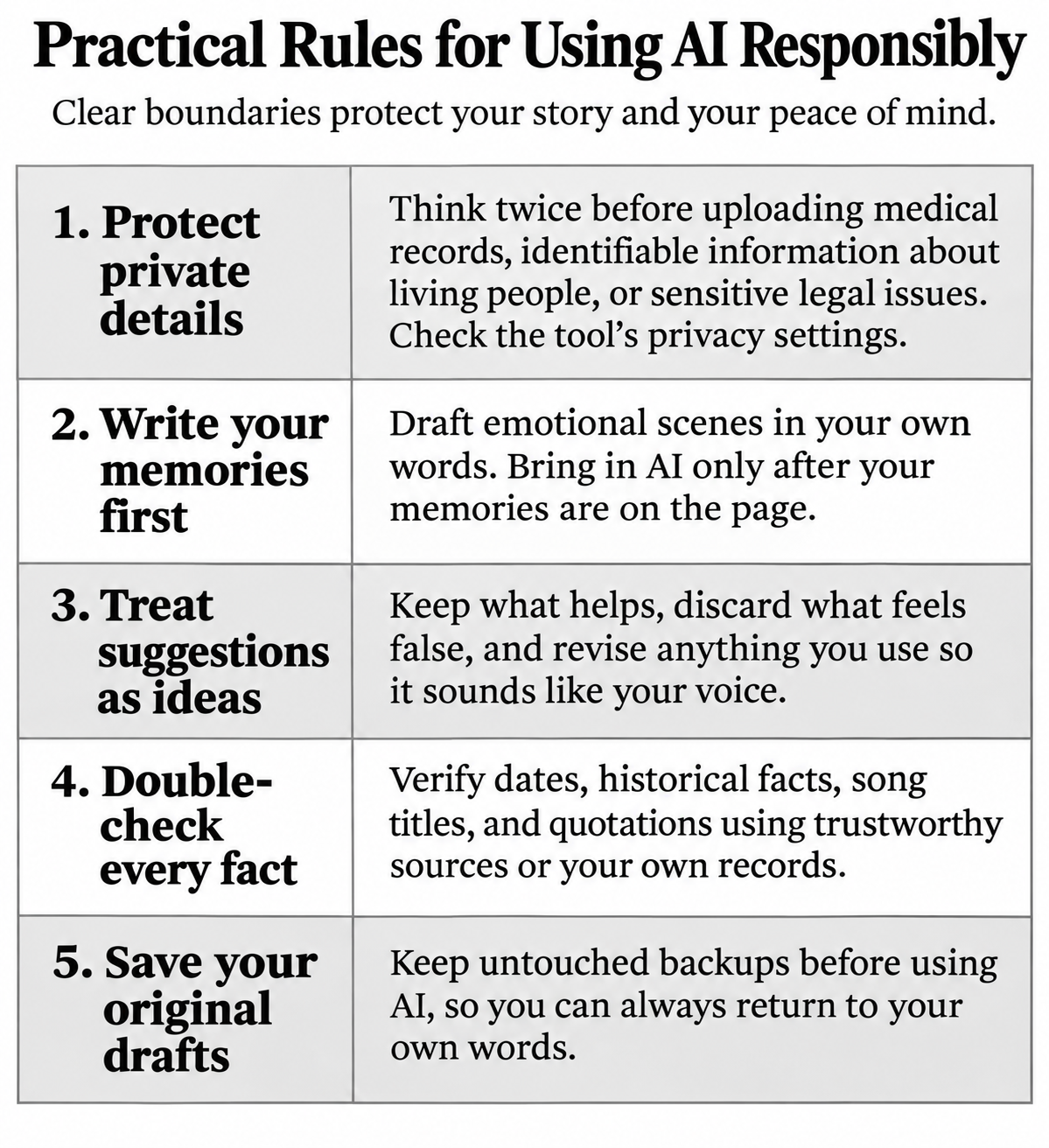
Practical Rules for Using AI Responsibly
If you decide to bring AI into your writing process, setting clear boundaries will protect both your story and your peace of mind.
A 5-Step Workflow for Memoirists Working with AI
This Workflow was suggested by AI. Here is a practical way to combine your personal storytelling with AI assistance without losing control of your narrative:
| Step 1: The Raw Dump (Human Only) | Sit down and write your memory or scene relying purely on your own mind and senses. Don’t worry about grammar, flow, or pretty sentences yet. Just capture what happened and how you felt in the moment. |
| Step 2: The Structural Map (Collaborative) | Use AI to help sort out your notes, lay out a timeline, or brainstorm whether the chapter flows better chronologically or thematically. |
| Step 3: The Deep Interrogation (Human Only) | Step back and ask yourself the tough questions: What was my part in this? What did I take away from it? What am I still hesitant to admit? Write these reflections out yourself. |
| Step 4: The Diagnostic Polish (Collaborative) | Share parts of your draft with an AI tool to test how it reads: ask it to point out passive phrasing, flag clunky transitions, or highlight spots where a reader might get confused. |
| Step 5: The Final Read-Aloud (Human Only) | Read your manuscript out loud to yourself. If a sentence feels stiff or doesn’t sound like something you’d say, rewrite it. You get the final say on every single word. |
A simple way to work
Begin by writing or recording a memory yourself. Preserve that original. Then give AI one limited task: ask follow-up questions, suggest an outline, or identify a confusing passage.
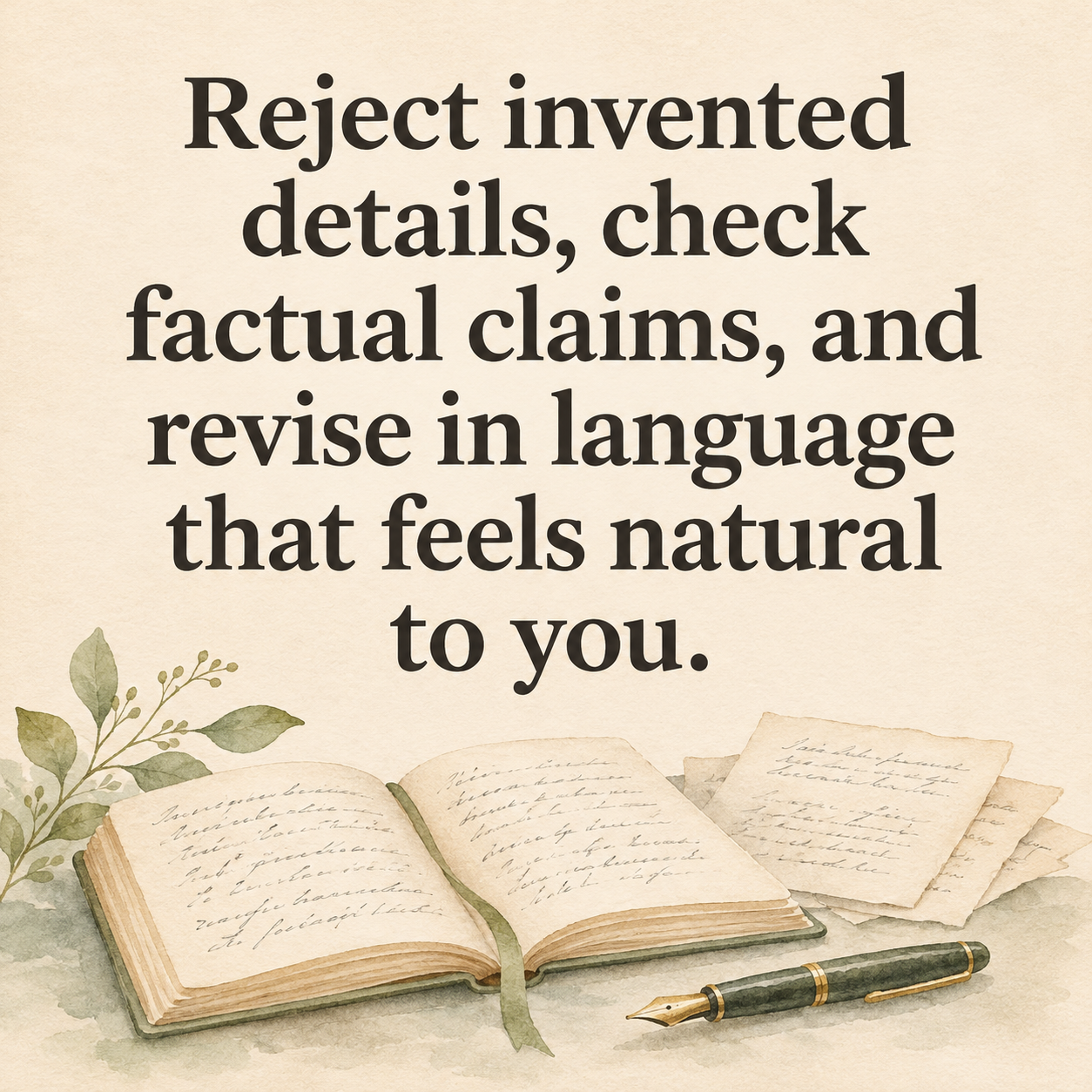
Review the response against your memory and sources. Reject invented details, check factual claims, and revise in language that feels natural to you. Before sharing the work, read it aloud and consider both its accuracy and its treatment of other people.
You can also keep a brief note of how you used AI. That makes its contribution easier to explain if an editor, publisher, or reader asks.
You do not need AI to write a memoir. If it helps you begin, organize, or revise, use it deliberately. The important work remains choosing what to tell and finding words you can stand behind.
Have a story you want to preserve? Lifetales Media offers interviewing, writing, editing, and coaching to help you turn your memories into a book. Visit lifetalesmedia.com.

QUICK NOTE: I never use AI (other than for grammar) when I create stories for other people. I might suggest that YOU use it to help you get organized, but I would never use it to write for clients. What you get from me is all me, and you are free to use it as you see fit. In affect, I am your ghostwriter.

