
Pip: Welcome to Lifetales Media — where the past isn’t just prologue, it’s apparently due for a room of its own.
Mara: Karen Yvonne Hamilton has a post out that’s genuinely practical: how to build a dedicated space at home for your family’s history. We’re talking archives, displays, workspace, the works. Let’s get into it.
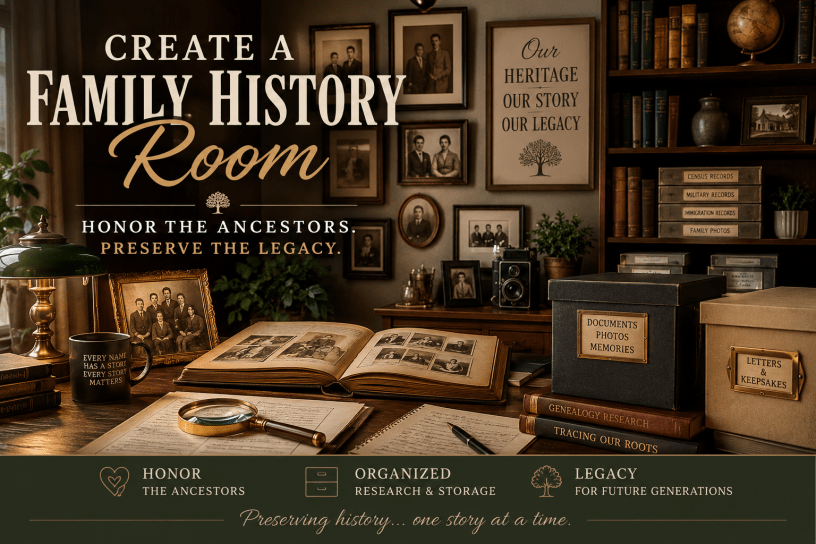
Create a Family History Room
Pip: The premise here is that most family historians focus entirely on finding the next record — but the physical space where that research lives is just as worth designing intentionally.
Mara: The post puts it this way: “It’s a workspace, an archive, a library, and a tribute to the people whose lives made yours possible.”
Pip: That framing shifts the whole project. This isn’t about storage — it’s about making the research feel like it means something while you’re doing it.
Mara: The post breaks the room into distinct zones. Display space for ancestor photographs, military medals, family Bibles, vintage letters, shadow boxes. The idea is that physical objects on the wall keep you anchored to real people rather than just names in a database.
Pip: And then there’s the honest aside about the workspace itself — she admits her actual research happens in a separate, admittedly messy office, and the history room is purely for storage and display. Which is a genuinely useful permission slip.
Mara: The filing guidance is specific: acid-free folders, archival boxes, fire-resistant cabinets, waterproof containers for originals. And there’s a useful benchmark — “if you cannot find a document in thirty seconds, your filing system probably needs improvement.”
Pip: Thirty seconds. That’s a brisk audit.
Mara: There’s also a library component — local history books, county histories, DNA reference guides, your own written family histories — and a storytelling corner, a comfortable chair where you read journals or simply sit with old photographs.
Pip: That last one matters. The post is making the case that genealogy includes a contemplative mode, not just an active research mode.
Mara: The section on making the room welcoming to younger family members is practical too — rotating displays like an Ancestor of the Month or a family migration map give grandchildren something to ask questions about. The post notes one grandchild who loves wandering the room specifically because history is visible rather than boxed away.
Mara: And the closing note is worth keeping: leave empty shelves. The room should never feel finished, because you’re not only preserving the past — you’re building the record future descendants will find.
Pip: The stories you’re collecting now are already someone else’s history.
Pip: A room that holds the past so the present can actually use it — that’s the throughline here.
Mara: Until next time on Lifetales Media.
Read the post Creating a Family History Room


