
Family history can become an expensive hobby surprisingly quickly.
Here are some of the best free tools every family historian should know about.
Subscriptions, archive fees, DNA tests, record copies, genealogy software, books, and travel can all add up. Fortunately, some of the most useful resources available to family historians cost absolutely nothing.
In fact, before paying for another subscription, it is worth exploring what you can accomplish with free genealogy websites, digital archives, libraries, mapping tools, and organization resources.
1. FamilySearch
If you use only one free genealogy website, make it FamilySearch.
Operated by FamilySearch International, the site provides free access to billions of historical records, family-tree profiles, photographs, and other genealogical materials from around the world. (FamilySearch)
You may find:
- Birth, marriage, and death records
- Census records
- Church registers
- Immigration and passenger lists
- Probate records
- Land records
- Military records
- Digitized books
- Historical images
FamilySearch also includes a collaborative family tree where researchers can connect individuals across generations.
One particularly valuable feature is the FamilySearch Catalog. Even when a record does not appear in a basic name search, the catalog may reveal collections available for the town, county, parish, or country where your ancestor lived.
Family history tip: Search by location as well as by name. Many records have been digitized but are not fully indexed.
2. The National Archives
For anyone researching ancestors in the United States, the National Archives and Records Administration, commonly called NARA, should be part of your research toolbox.
The National Archives preserves federal records relating to census research, military service, immigration, naturalization, land, and many other subjects useful to genealogists. Its genealogy section also provides research guides, charts, forms, videos, and links to digitized material. (National Archives)
Not every National Archives record has been digitized, but the website can help you determine:
- What records exist
- Where they are located
- What years survive
- How collections are organized
- Whether records can be viewed online
That information alone can save hours of searching in the wrong place.
An added bonus: researchers visiting National Archives facilities can access certain subscription genealogy databases there without paying for their own subscriptions. (National Archives)
3. Chronicling America

Never underestimate old newspapers.
A census may tell you where your ancestor lived. A newspaper might tell you what happened at their wedding, what business they operated, which relatives attended their funeral, or why they suddenly left town.
Chronicling America, from the Library of Congress, provides free searchable access to millions of pages of historic American newspapers, with coverage extending through 1963. (The Library of Congress)
Search for:
- Obituaries
- Marriage announcements
- Birth notices
- Court cases
- Business advertisements
- Social columns
- Accidents
- Military news
- Property sales
- Community events
Try searching surnames alongside locations, occupations, street names, schools, churches, or relatives.
And remember that newspaper OCR is imperfect. If searching McDonald produces nothing, try M’Donald, MacDonald, or simply search the town and browse manually around an important date.
4. Find a Grave

Cemeteries can reveal far more than dates carved into stone.
Find a Grave allows users to search cemetery memorials, view photographs, locate burial places, and sometimes discover links between relatives. (Find a Grave)
A memorial might contain:
- Birth and death dates
- Cemetery location
- Grave photographs
- Obituary information
- Spouse or parent connections
- Maiden names
- Biographical details
Find a Grave remains free to use, although optional sponsorship features are available. (Find a Grave News)
There is one important rule, however:
Treat memorial information as a clue, not automatically as proof.
Much of the information is contributed by users. Whenever possible, compare it with death certificates, cemetery records, obituaries, church registers, or other original sources.
5. The Library of Congress
The Library of Congress is a treasure chest for family historians, particularly when you want to move beyond names and dates.
Its collections include photographs, maps, newspapers, books, manuscripts, local histories, oral histories, and other materials that can help reconstruct the world in which your ancestors lived.
The Library’s Local History and Genealogy collections include more than 100,000 U.S. and international local histories and tens of thousands of compiled family histories. (Research Guides)
Even when you cannot find your ancestor by name, search for their:
- Town
- County
- Occupation
- Church
- Ethnic community
- Military unit
- Neighborhood
- Historical event
Genealogy becomes much richer when you understand the community surrounding your ancestor.
6. Internet Archive

The Internet Archive is one of the best places to search when you are trying to reconstruct a community rather than simply locate an individual record.
Its enormous digital collection includes historical books, government publications, directories, census publications, local histories, genealogies, and other out-of-copyright materials.
Historic city directories are especially useful. Digitized directories in the Internet Archive can provide addresses, occupations, business information, and sometimes details about widows or deceased householders. (Internet Archive)
Try searches such as:
“Key West city directory 1900”
or
“Monroe County Florida history”
or
“Hamilton family genealogy Georgia”
Do not search only for a person’s name. Search for the books and records that might contain that person.
7. Google Books
Google Books is another resource family historians sometimes overlook.
Millions of digitized books can be searched by keyword, including older county histories, genealogies, biographies, directories, government reports, and historical publications. Some older works are available in full view. (Google Books)
Search combinations such as:
Surname + county
Surname + town
Family name + genealogy
Town + history
Occupation + location
A family may receive only two paragraphs in an old county history, but those paragraphs could contain clues unavailable anywhere else.
8. State Archives and State Libraries
One of the biggest mistakes in genealogy is searching only the large national databases.
State archives and state libraries often have wonderful free digital collections.
Depending on the state, you might discover:
- Historic photographs
- County records
- Death indexes
- Confederate or Union pension records
- Land documents
- Maps
- Manuscripts
- Newspapers
- Voter registrations
- School records
- Territorial records
- Oral histories
Search the web for:
“[State name] digital archives genealogy”
Then repeat the process for the state library, historical society, and university libraries.
Local collections are often where the really interesting stories begin.
9. Local Library Digital Collections
Your library card may be one of your most valuable genealogy tools.
Many public libraries provide patrons with remote access to databases that would otherwise require subscriptions. Available resources vary widely by library system.
Libraries may also offer access to:
- Historic newspapers
- Local obituary indexes
- City directories
- Heritage collections
- Sanborn maps
- Genealogy databases
- Digitized photographs
- Local history books
Ask a librarian specifically:
“What genealogy and historical newspaper databases can I access with my library card?”
You may be pleasantly surprised.
10. Free Genealogy Forms and Research Logs
Finding records is only half the job.
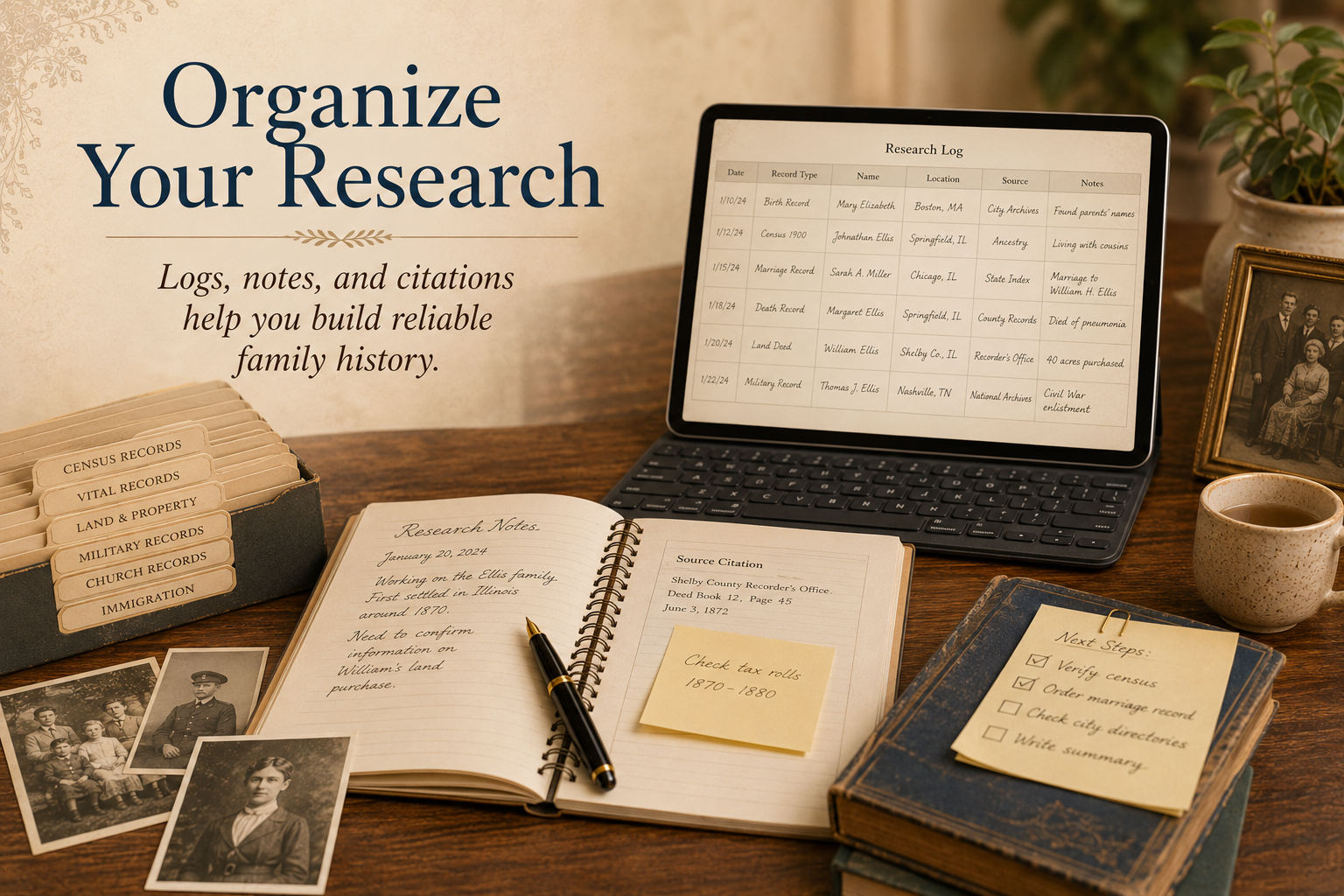
You also need to keep track of what you searched, where you searched, and what you found.
The National Archives offers free genealogy charts and forms as part of its resources for family historians. (National Archives)
You can also create your own simple research log using Google Sheets or another free spreadsheet program.
Useful columns include:
- Ancestor
- Research question
- Repository
- Collection searched
- Date searched
- Search terms
- Results
- Source citation
- Next step
A research log prevents something every genealogist eventually does:
Searching the same collection three times because you forgot you already checked it.
11. Google Maps
Google Maps may not look like a genealogy program, but it can be remarkably useful.
Use it to locate:
- Old family homes
- Cemeteries
- Churches
- Courthouses
- Schools
- Historic neighborhoods
- Migration routes
Street View can sometimes even help you see whether a house, church, or neighborhood connected with your family still exists.
Combine modern maps with historical maps whenever possible. Seeing where people lived in relation to churches, workplaces, relatives, waterways, railroads, and county boundaries can reveal relationships that are difficult to see on a pedigree chart.
12. Your Smartphone
One of the best free genealogy tools may already be in your pocket.
Your phone can become a portable family-history workstation.
Use it to:
- Photograph cemetery markers
- Scan documents
- Record oral-history interviews
- Photograph family albums
- Take research notes
- Record locations
- Photograph archive boxes and call numbers
- Capture family heirlooms
- Scan handwritten letters
When visiting an archive, photograph the identifying information for the collection before photographing the records themselves.
Years from now, knowing exactly where that photograph came from may be just as important as the photograph.
13. Your Own Family

This resource is completely free—and often terribly underused.
Before searching another database, talk to your relatives.
Ask them about:
- Childhood homes
- Grandparents
- Family traditions
- Nicknames
- Schools
- Jobs
- Military service
- Migrations
- Holidays
- Recipes
- Family disagreements
- Courtships
- Neighborhoods
- Stories everyone used to tell
Then ask one of the best questions in family history:
“Who else should I talk to?”
A ninety-year-old cousin may know something no archive ever recorded.
Free Does Not Mean Unimportant
Some researchers assume that the best genealogy records must be hidden behind subscription walls.
They aren’t.
Paid databases can be extremely helpful, but successful genealogy has never been about collecting subscriptions. It is about knowing where records were created, why they were created, where they survive, and how to interpret them.
A skilled researcher using free resources can uncover an extraordinary amount of family history.
- Start with FamilySearch.
- Explore the National Archives.
- Search old newspapers.
- Visit digital libraries.
- Browse old books.
- Walk cemeteries.
- Talk to relatives.
- And above all, document what you discover.
Because the goal of family history isn’t simply to collect more names. It is to recover the lives behind them. Every census record, newspaper clipping, photograph, grave marker, letter, and family story is another piece of the larger story your family left behind. And sometimes the clue that finally opens that story doesn’t cost a penny.
Preserving history…one story at a time.

