

You don’t need to remember your entire life before you begin writing a memoir. You only need one memory, a little time, and a place to put your words.
This 30-day plan will help you gather memories, find a story you want to tell, and write a first draft. Set aside 15 to 20 minutes each day. Write freely, and let the details you remember lead you forward.

Week One: Gather Your Memories
Day 1 — Choose your writing place. Open a notebook or document just for your memoir. I suggest keeping a small notebook with you so you jot down memories anytime. Some people use a recording app on their phone to speak their memory when there isn’t time to write it down. TODAY’S TASK: Write one sentence about why you want to tell your story.

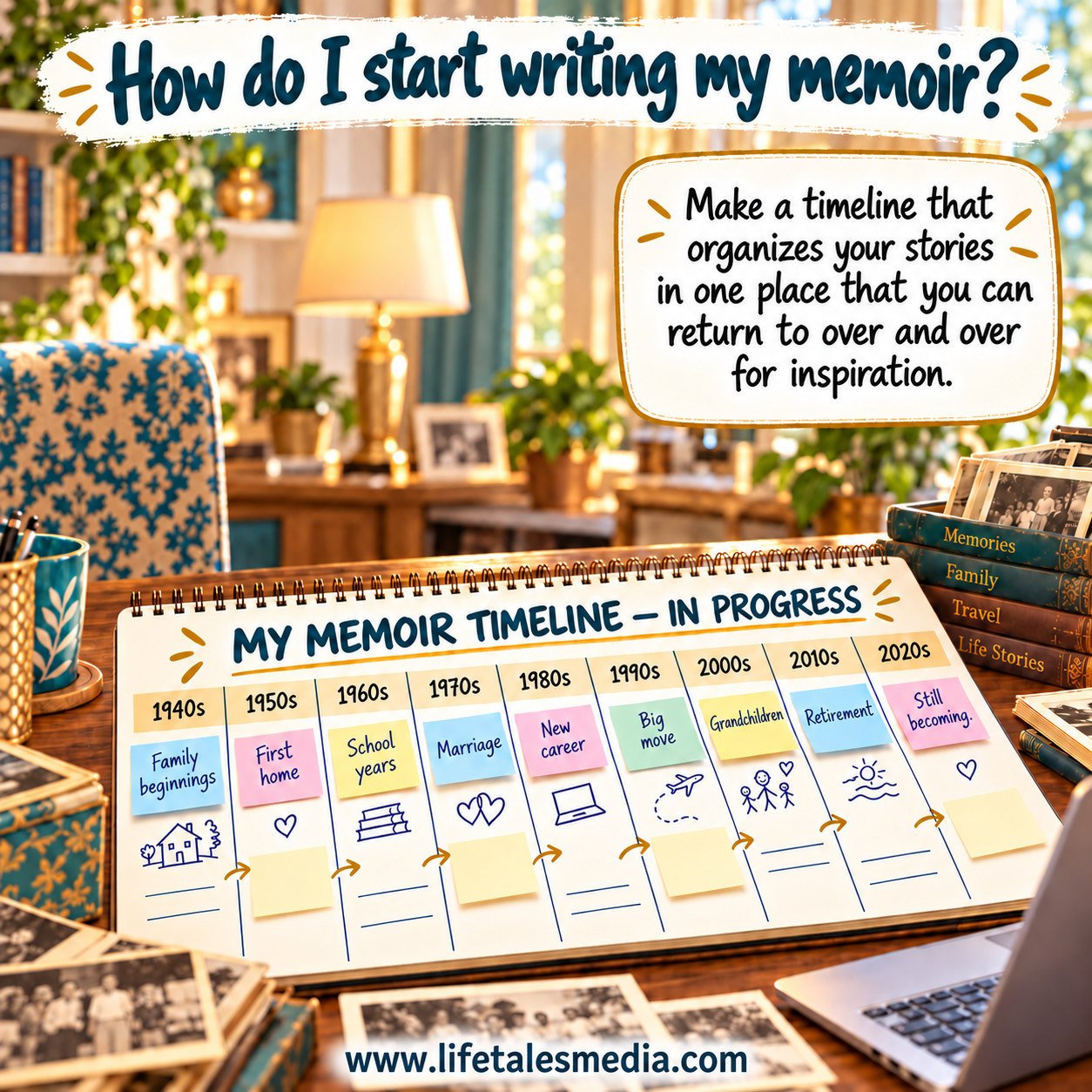
Day 2 — Make a life timeline. Draw a line from your earliest memories to today. Mark the decades and add places, people, moves, celebrations, and turning points. Leave plenty of space to add more later.
Day 3 — List the places you remember. Include homes, schools, workplaces, streets, and places you visited often. Which one can you picture most clearly?
Day 4 — List the people who shaped you. Write down names without worrying yet about their role in the story.
Day 5 — Find a memory in an object. Choose a photograph, recipe, letter, piece of clothing, or keepsake. Write about where it came from and what it brings back.
Day 6 — Write about an ordinary day. Describe a routine from another season of your life. What did you hear, smell, or do without thinking?
Day 7 — Reread your notes. Circle three memories you would like to explore. Notice which ones still raise a question or a strong feeling.
Week Two: Explore the Stories

Day 8 — Write a childhood scene. Begin with a particular moment: a meal, a walk home, a conversation, or a day you got into trouble.
Day 9 — Write about a relationship. Show a moment that helps a reader understand what this person meant to you.
Day 10 — Write about a choice. What decision changed the direction of your life? Start with the day you made it.
Day 11 — Write about a challenge. Describe what happened and what you understood at the time. You can leave later lessons for later.
Day 12 — Write about joy. Recall a moment when you felt at home, proud, surprised, or deeply happy.
Day 13 — Write about change. Choose a moment when something familiar ended or something new began.
Day 14 — Look for a connection. Read what you have written this week. Which memories seem to belong together? Give that group a working title.
Week Three: Shape a Short Memoir

Day 15 — Choose one story. Pick a period, relationship, or turning point from your notes. A memoir can focus on one part of a life; it does not have to cover every year.
Day 16 — Write the central question. What were you trying to understand, decide, survive, or become during this time?
Day 17 — Choose your opening moment. Find a scene that places the reader close to the action. Where are you? Who is there? What is happening?
Day 18 — List five key scenes. Put them in the order you want to tell them. Leave room for memories that surface as you write.
Day 19 — Draft the opening scene. Describe what you saw and did. Include dialogue if you remember it, and mark any words you are unsure of to check later.
Day 20 — Draft the next scene. Let the reader see what changed after the opening.
Day 21 — Add your perspective. What did you believe then? What do you understand differently now? Both viewpoints belong in a memoir.
Week Four: Finish a First Draft

Day 22 — Write a scene of tension. Show a difficult conversation, a setback, or a moment when you did not know what would happen next.
Day 23 — Write a quiet scene. Give the reader a glimpse of daily life during this period.
Day 24 — Write the turning point. What happened that made it impossible for things to continue as they had?
Day 25 — Write what followed. Describe the immediate aftermath. What did you do next?
Day 26 — Draft an ending. Stop at a moment that shows where this experience left you. You can change the ending during revision.
Day 27 — Read the whole draft. Make a short list of missing scenes, confusing passages, and details you want to check. Resist the urge to fix everything today.
Day 28 — Fill one gap. Write the missing scene or paragraph that would most help a reader follow your story.
Day 29 — Revise for clarity. Check the order of events. Add names, places, and dates where they matter, and make clear when you are uncertain about a detail.
Day 30 — Give your story a title. Save a copy of your draft. Then write down one thing you discovered while telling it and one question you want to explore next.
Your Story Can Begin Small

After 30 days, you may have a complete short memoir, the beginning of a longer one, or several scenes you want to keep developing. Each is a worthwhile result.
If you miss a day, pick up where you left off. If a memory takes longer than one session, stay with it. The plan is here to give you a path into your story, and you can return to it whenever you need a place to begin.
Join us on our Facebook group for support in writing your memoir! You can ask questions and join a community of people who are also working on memoirs. https://www.facebook.com/groups/1074129842379624
BLANK TIMELINE WORKSHEET
Here is a pdf of the Blank Timeline Worksheet that you can print out to keep handy and work on completing. You can access the computer version at:
https://docs.google.com/document/d/1e6R8wx5rd99gj2NW8D3R_obmneKrpFjpbMibej3iypk/edit?usp=sharing


Thank you, Karen ❤
LikeLike