
A chapter excerpt from The Story in the Records: Turning Genealogy Research into Compelling Stories by Karen Yvonne Hamilton
Chapter 1 of The Story in the Record: Mining the Archive for Narrative: Finding the Spark
Every genealogist knows the quiet thrill of finding an ancestor in an unindexed ledger or uncovering a long-lost marriage record in a courthouse vault. Yet when we look at those hard-won records, we often see only answers to factual queries: a date of birth, a date of marriage, an occupation, an enumeration district. We log the data into our software, attach the source citation, and move on to the next generation.
To write narrative nonfiction, you must learn to look at your research through a different lens. You are no longer merely assembling an administrative pedigree; you are looking for the narrative spark.
A narrative spark is rarely an explosion. It does not require your ancestor to have been a general charging into battle, an outlaw fleeing the frontier marshal, or an heiress fleeing a dynastic marriage. In narrative nonfiction, a story begins when a real human being meets real friction, a moment when their circumstances change, their security is threatened, or their available choices suddenly narrow.
When you learn how to read an archive for narrative friction, you will realize that your binders and digital folders are already bursting with drama. You do not need to invent tension. You only need to know how to spot where the historical record caught fire.
Events vs. Story-Bearing Events
Not every documented event in a family tree carries narrative weight.
An ancestor was born on a specific Tuesday in 1848; that is an event. It belongs on your pedigree chart and in your source footnotes. But unless that birth triggered a legal dispute, occurred during a perilous oceanic crossing, orphaned older siblings, or plunged a family into economic instability, it is not inherently a story-bearing event.
A story-bearing event is a historical occurrence that disrupted an existing equilibrium and forced a decision. It is a moment where what came after was fundamentally different from what came before.
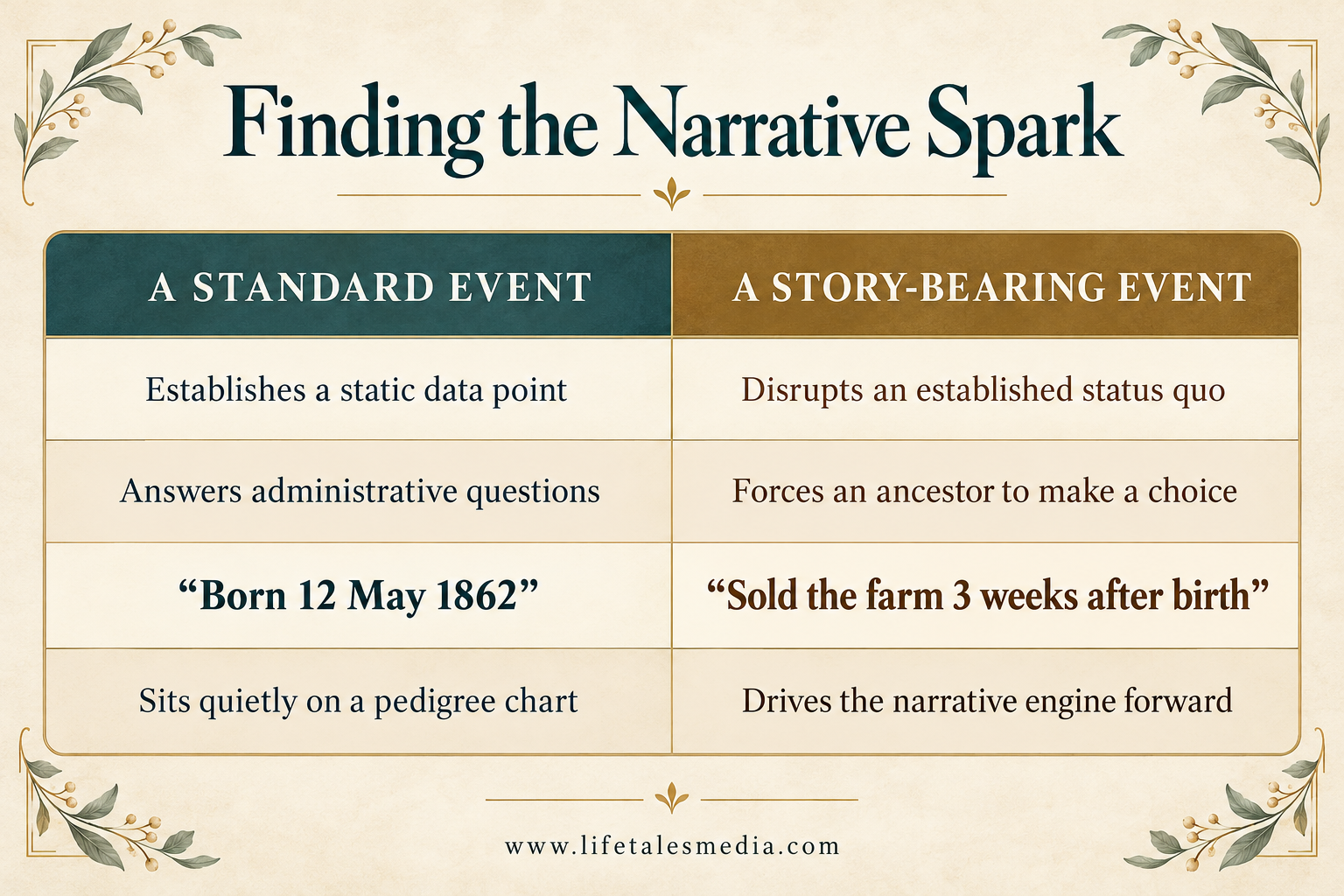
When scanning your research, look for moments where your ancestor was forced out of routine. Did an artisan suddenly become a day laborer? Did an entire household pack their belongings into a wagon within thirty days of a patriarch’s death? Did a mother surrender her property rights to secure guardianships for her children? These are story-bearing events: the pivot points where human beings navigate the pressure of historical reality.
Tipping-Point Records: Spotting the Pivot
Bureaucratic records are written in cool, dispassionate language. Clerks, enumerators, and court scribes had no interest in capturing family grief or triumphant survival; their mandate was property transfer, revenue collection, and legal liability.
To find the human story, you must learn to recognize Tipping-Point Records—documents that appear dry on the surface but mark irreversible transitions in a family’s trajectory.
TIPPING-POINT RECORDS
| ECONOMIC SHIFTS | LEGAL / CUSTODIAL | PHYSICAL DISRUPTION |
| Sheriff tax sales | Probate disputes | Abrupt county-line |
| Foreclosure dockets | Minor indentures | Migrations |
| Chattel mortgages | Pension rejections | Sudden enlistments |
| Insolvency filings | Asylum admissions | Name/identity changes |
Consider what these common records actually signify in human terms:
Tipping Point Records
| Record type | What to look for | Potential narrative tipping point |
|---|---|---|
| Land Foreclosures and Sheriff’s Sales | Auction notices or entries recording the forced sale of land or personal property. | Loss of a household’s economic foundation, accumulated family equity, social standing, or residential stability. |
| Probate and Estate Disputes | Proceedings spanning multiple court terms; competing petitions; heirs’ objections; heirlooms sold to settle debts. | Family relationships fracture under financial strain as inheritance, obligations, and loyalties collide. |
| Widow Pension Applications and Rejections | Claims rejected for “insufficient proof of marriage” or “death not incurred in line of duty”; repeated appeals or requests for evidence. | A widow faces a livelihood crisis while struggling to establish her eligibility for support. |
| Sudden Occupational Shifts | A marked change in occupation, property ownership, or housing—for example, a master blacksmith who owned property in 1880 becoming a foundry day laborer renting in 1900. | A possible loss of income, independence, or status. Investigate mechanization, injury, economic depression, and other explanations. |
| Institutional Admissions | Admission ledgers for poorhouses, psychiatric institutions, or sanatoriums; accompanying petitions and correspondence. | Illness, hardship, or family circumstances lead to institutional care, potentially changing relationships and household responsibilities. |
| Name Alterations and Orthographic Breaks | Surname changes at naturalization; aliases in court records; abrupt departures from established spellings. | A possible effort to navigate prejudice, avoid legal consequences, or reshape identity. First distinguish deliberate changes from clerical errors and spelling variations. |
These records offer leads, not conclusions. Corroborating evidence helps establish what changed, why it changed, and what choices followed.
The record itself is administrative ink on rag paper. The consequence was a radically altered human life.
Reading Records for Friction: The Four Diagnostic Questions
Whenever you examine a source in your files, interrogate it with four diagnostic questions designed to surface narrative tension:
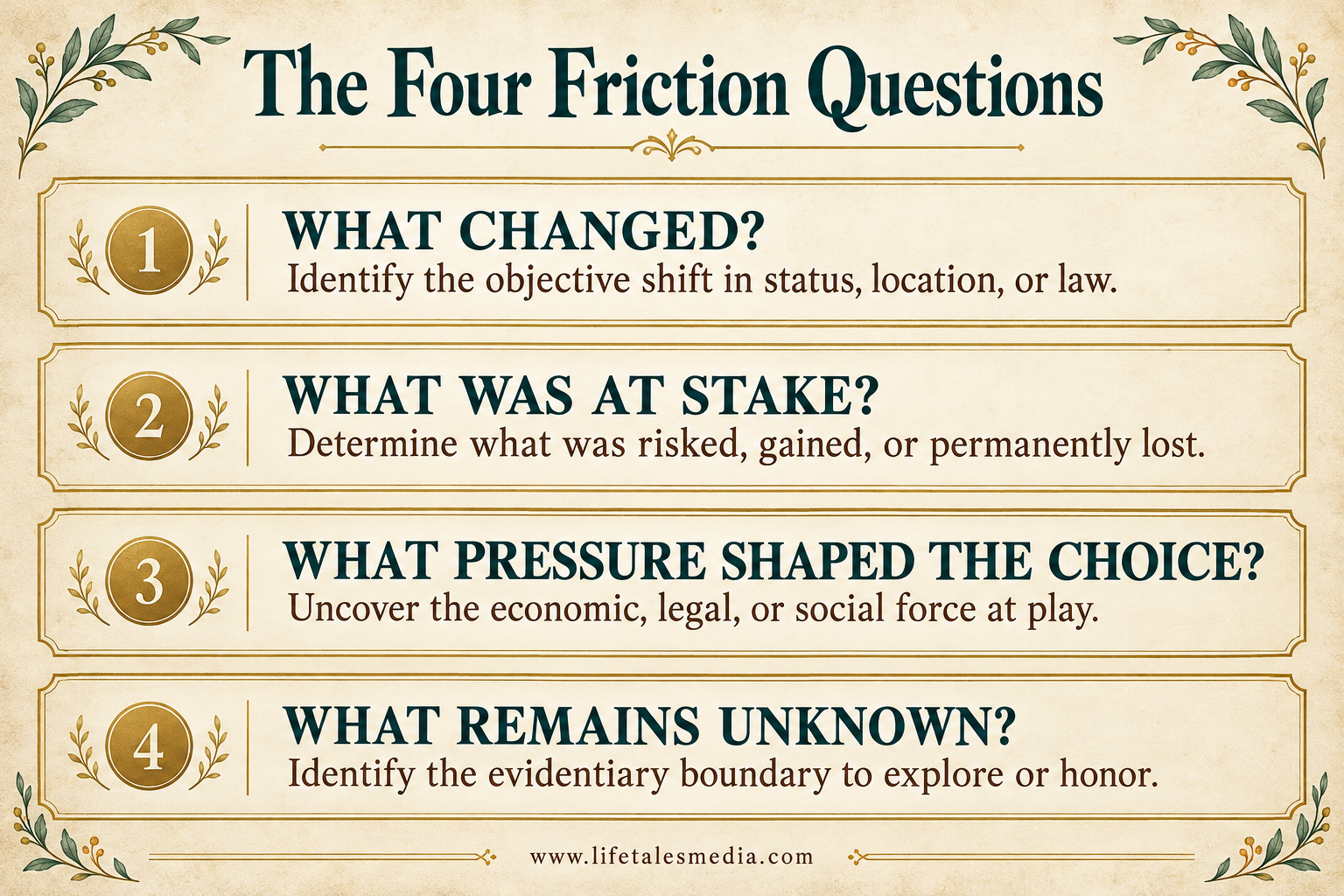
Diagnostic Example: The Census Occupational Shift
Imagine an ancestor, Caleb, appearing in two consecutive federal censuses:
- 1870 Census: Caleb (age 34), Farmer, Real Estate: $2,500, Personal Estate: $600. Household includes wife and 4 children. Location: Wayne County, Ohio.
- 1880 Census: Caleb (age 44), Teamster (Rents home). Household includes wife and 6 children. Location: Cleveland, Cuyahoga County, Ohio.
Applying the four questions:
- What changed? Caleb lost land ownership, abandoned agricultural work, and moved his family from a rural township to an industrializing urban core.
- What was at stake? The family’s economic independence, generational inheritance, and physical living environment. In 1870, they controlled their food production; by 1880, they were entirely dependent on wage labor and subject to urban living costs.
- What pressure shaped the choice? Looking at historical context reveals the Panic of 1873—a devastating financial crash that collapsed agricultural commodity prices and triggered nationwide farm foreclosures.
- What remains unknown? Did Caleb sell voluntarily to pay creditors, or was he foreclosed upon? Did an injury force him out of field labor? (The next research step: search Wayne County deed indexes for a sheriff’s sale or foreclosure decree between 1873 and 1879).
Finding the Story in Gaps, Silences, and Contradictions
Genealogists are conditioned to view gaps and contradictions as problems to be solved. To the narrative nonfiction writer, however, a gap is often where the most significant story lives.
Historical archives are inherently biased toward property-owning men, institutional authorities, and moments of state regulation. The voices of women, enslaved people, impoverished laborers, and marginalized communities were systematically excluded or recorded only when they came into contact with the law or charity.
When an ancestor disappears from the records for a decade, or when their marital status contradicts itself from one record to the next, do not simply treat it as an administrative annoyance. Ask what lived reality produced the silence:
- The Missing Enumeration: A mother who vanishes from census returns while her young children are scattered across relatives’ farms often indicates sudden maternal mortality, institutionalization, or abandonment during economic distress.
- The Contradictory Birthplace: An ancestor who claims to have been born in New York on an enlistment record, but whose death certificate lists Ireland, points directly to the anti-immigrant nativism of the 1850s, where foreign birth was a barrier to employment or enlistment bounties.
- The Erased Parent: A marriage record listing only the bride’s mother while leaving the father’s line blank suggests non-marital birth, paternal desertion, or an unacknowledged relationship.
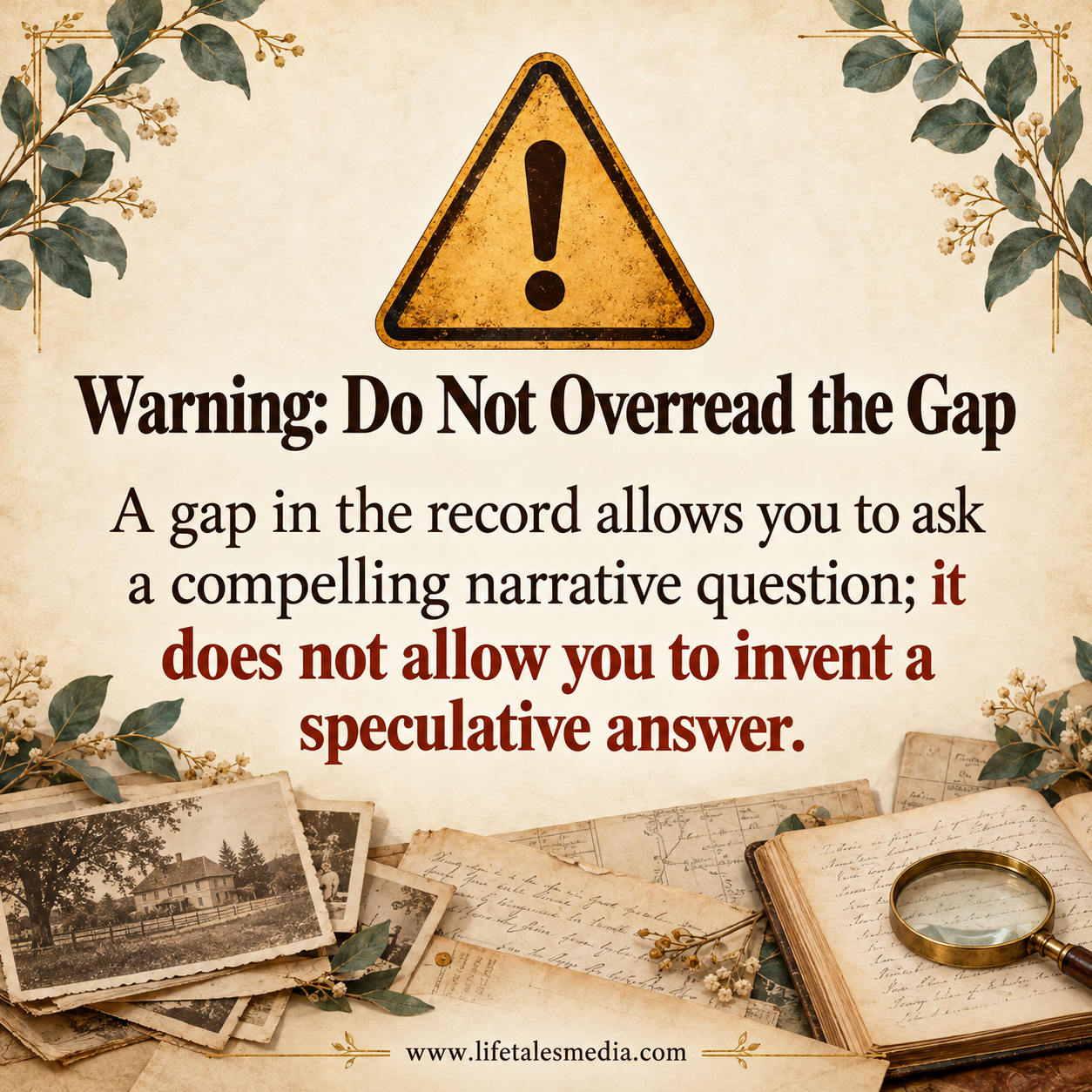
Warning: Do Not Overread the Gap
A critical rule under the Contract of Truth: A gap in the record allows you to ask a compelling narrative question; it does not allow you to invent a speculative answer.
| PRODUCTIVE INQUIRY | UNETHICAL ASSUMPTION |
| “Because no marriage record exists in the county ledger, their union may have been common-law or celebrated in a neighboring jurisdiction without state licensing.” | “Because no marriage record exists, John and Mary defiantly lived in sin, flouting the moral traditions of their puritanical village in a passionate act of rebellion.” |
Treat the gap with dignity. Acknowledge what cannot be known. The reader will trust you far more if you say, “The county records fall silent in 1882, leaving it impossible to determine whether Mary left by choice or was forced out by her husband’s creditors,” than if you invent an unsupported domestic scene.
The Conflict Matrix
To sustain a reader’s attention over multiple chapters, a story requires varied sources of friction. In human lives, conflict occurs across four distinct dimensions. When mining your archive, map your ancestor’s documented turning points against The Conflict Matrix:
| 1. ENVIRONMENTAL & ECONOMIC• Crop failures, blights, floods• Panics, recessions, wage cuts• Epidemics, industrial hazards | 2. INSTITUTIONAL & LEGAL• Military drafts, enlistments• Discriminatory statutes • Inheritance laws, coverture |
| 3. INTERPERSONAL & FAMILIAL• Contested wills, disinheritances• Custody battles, desertions• Sibling rivalries over property | 4. INTERNAL & EXISTENTIAL • Religious conversion/schism • Grief following sudden losses • (Requires verified documentary anchors; handle with care) |
Working with the Matrix
- Assign a Primary Tension: Identify the overarching historical pressure driving the ancestor’s life (e.g., land exhaustion in 1850s Virginia).
- Layer Secondary Tensions: Identify the relational or institutional frictions that collided with that primary pressure (e.g., an intestate probate settlement forcing the sale of enslaved people and property to divide assets among six competing siblings).
- Handle “Internal Conflict” with Ethical Restraint: You cannot claim to know your ancestor’s private doubts, fears, or psychological crises unless you have a diary, a personal letter, a church confession, or a direct testimony. When those sources are absent, internal conflict must be framed strictly through documented choices under heavy pressure:
“Faced with three straight years of ruined wheat crops and mounting interest on his mortgage, Thomas had to choose between staying on ancestral land or abandoning his equity to start over in the Kansas territories.”
Record-to-Story Transformation: The 1870 Agricultural Census
To see how an ordinary non-population schedule transforms into compelling narrative prose without violating historical truth, study this transformation.
1. The Raw Record
- Source: 1870 U.S. Federal Census, Non-Population Schedule (Agriculture), Mercer County, Missouri.
- Name of Owner/Agent: William H. Vance.
- Land Data: 12 acres improved (cleared/cropland); 68 acres woodland/unimproved.
- Cash Value of Farm: $240. Value of Farming Implements: $15.
- Livestock: 1 working mule, 1 milk cow, 4 swine. Total Livestock Value: $90.
- Crops Produced: 40 bushels of Indian corn; 0 bushels of wheat, oats, or barley.
- Estimated Value of All Farm Production: $110.
- Township Average (Context): Neighboring farms averaged 45 improved acres, $1,200 property value, and 300+ bushels of corn.
2. The Overdramatic and Unsupported Version (Violating the Contract of Truth)
William collapsed against the fence rail, wiping salty sweat from his eyes as he stared at his miserable twelve acres. His heart ached with bitter disappointment. He hated the mule, and he cursed the day he had ever brought his beloved Sarah to this barren Missouri wasteland. He thought of his father’s prosperous farm in Ohio and wept openly, knowing that his children would starve when the winter blizzards came howling across the plains.
Why this fails: Every single psychological assertion is invented. The writer has no evidence that William collapsed, hated his mule, wept, or compared himself to his father. It turns history into cheap melodrama and destroys the reader’s trust.
3. The Disciplined Narrative Nonfiction Version (Grounded and Truthful)
When the census enumerator turned down William Vance’s lane in the summer of 1870, he recorded the profile of a household living on the extreme margins of the Missouri timberline. While neighboring farmers in Mercer County had cleared an average of forty-five acres and produced several hundred bushels of grain, Vance had wrested just twelve improved acres from the sixty-eight acres of thick oak and hickory woodland he owned.
His entire farm was valued at $240—less than a quarter of the township average. With only fifteen dollars’ worth of tools and a single working mule, clearing even an acre of dense root systems required weeks of back-breaking manual labor. That season, the farm yielded just forty bushels of corn and not a single bushel of wheat or oats. For a family of six, forty bushels of corn represented mere subsistence calories, leaving almost nothing to take to market after winter seed was set aside. Every transaction on the farm was an exercise in precise survival, where the loss of that lone mule or cow would have collapsed the entire enterprise.
Why this works: It is evocative, powerful, and dramatic, yet every single fact and deduction is anchored in the record and comparative county data. It respects the ancestor’s genuine struggle without manufacturing artificial theatrics.
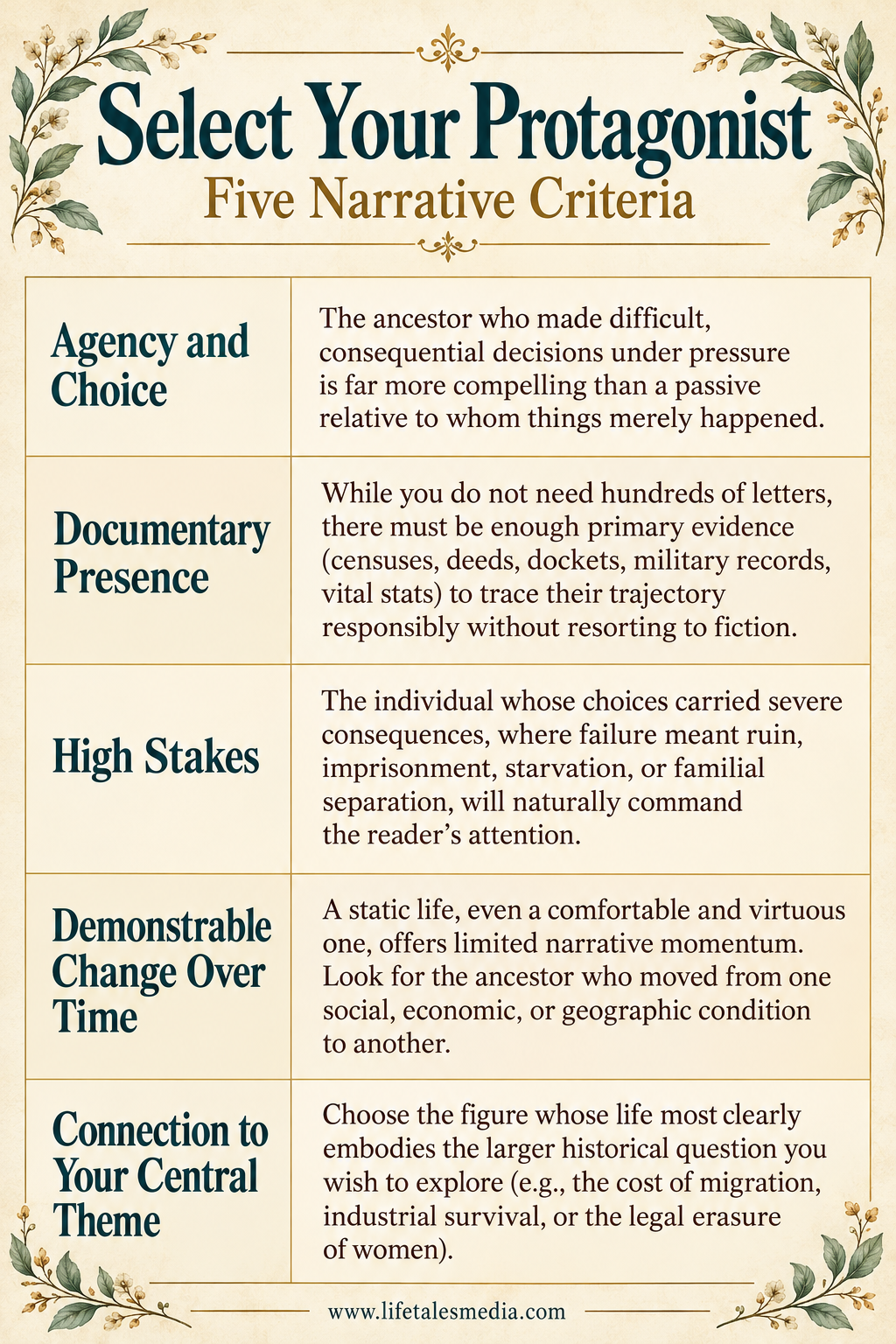
Choosing Your Protagonist: Five Essential Criteria
When researching a family line, you are often tracking multiple individuals across the same era, a father, a mother, six children, and an assortment of in-laws. How do you decide who should be the primary protagonist of your narrative?
Many writers fall into the Documentation Trap: they make someone the protagonist simply because that person generated the most paperwork (e.g., a lawyer uncle who left three boxes of ledgers, or an ancestor who served in local government). But sheer volume of documentation does not guarantee a compelling story.
Once you have identified your narrative spark, you have transformed your ancestor from a static name on a pedigree chart into an active human being navigating a real-world struggle.
In The Story in the Records: Turning Genealogy Research into Compelling Stories, Karen Yvonne Hamilton delivers a clear, comprehensive masterclass in transforming raw family data into immersive narrative nonfiction. You do not need to fabricate conversations, invent melodrama, or guess what ancestors thought to bring their worlds to life. Guided by the Contract of Truth, you will learn how to honor the historical record while constructing dramatic narrative arcs, building three-dimensional characters from legal evidence, and staging vivid scenes grounded in physical detail.

